
Now Available!
Virtual book launch party will be
on June 15, 2026
Please join us! Sign up for my newsletter below to stay informed.
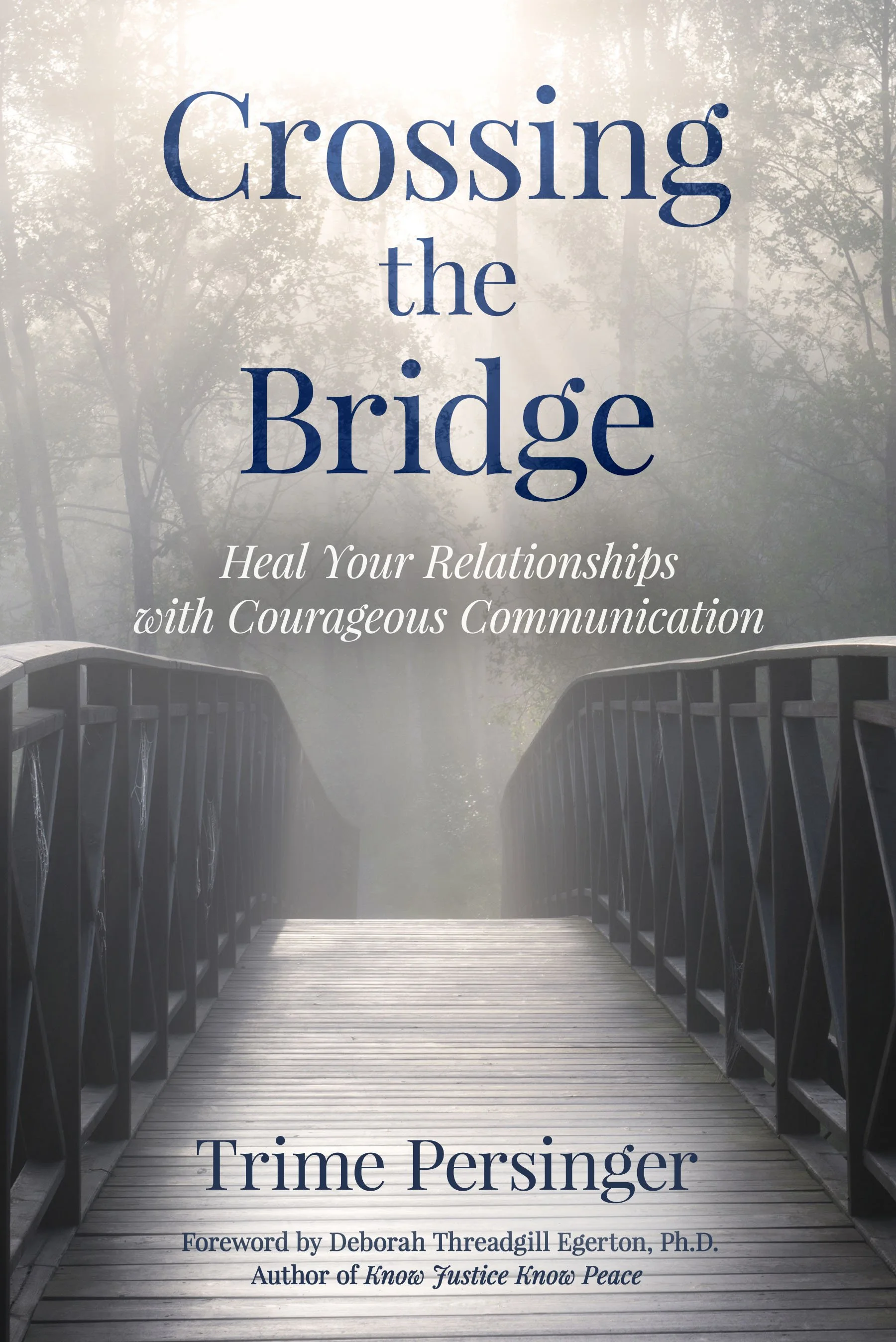
Crossing the Bridge helps you to overcome discord, heal your relationships, and enrich your life through practical tools, personal stories, and hard-earned wisdom.
Purchase the book on Amazon here.
Other booksellers will be listed soon.
Read the Foreword by Deborah Threadgill Egerton, Ph.D.
Praise for Crossing the Bridge
"When Trime Persinger felt dismissed in my rather rude email exchange, she
could have walked away. Instead, she demonstrated the very skills she teaches—reaching back across the divide with curiosity instead of defensiveness, sharing thoughtful research to bridge our differences, and modeling how authentic communication can transform conflict into connection. In both her writing and her living, Persinger shows us that crossing the bridge to understanding isn't just possible—it's transformational."
— Doug Lynam, author of Taming Your Money Monster:
9 Paths to Money Mastery With the Enneagram
“This book is more than a set of instructions on communication skills. It is also the story of Trime Persinger's determination to confront and repair the trauma of relationship breakdown in her personal life. I highly recommend this important book to any reader seeking to bridge the divide when barriers go up in difficult times."
— Susan Gillis Chapman, author of The Five Keys to Mindful Communication:
Using Deep Listening and Mindful Speech to Strengthen Relationships, Heal Conflicts, and Accomplish Your Goals
“As a psychotherapist, I found this book to be a useful and highly specific instruction manual for both laypeople and therapists/coaches to empower individuals to cultivate deeper connections. It fills a niche in the field that is currently devoid of specificity. I appreciated the plethora of concrete verbal strategies and purposeful skills that were particularly applicable in clinical settings. The book is infused with Trime's lived experience, which adds depth and color. A great addition to my therapist bookshelf!”
— Michele Lonergan, LPC, NCC, CNEP
"This insightful book is a wise and skillful guide to helpful and effective communication. Highly recommended."
— Gaylon Ferguson, author of Welcoming Beginner's Mind:
Zen and Tibetan Buddhist Wisdom on Experiencing Our True Nature
An Excerpt from Crossing the Bridge
Excerpted from Chapter 15—‘I’ Language
While crossing the bridge is essential for effective communication, it’s only half the story. You matter too. There will come a time to cross back to your side of the bridge, and in this chapter I will present skills for doing that.
Although I am shifting gears, I want to make one final push for crossing the bridge. In most conversations, I cross the bridge before I express my own perspective or experience. By crossing the bridge first, I make sure that I clearly understand the other person’s perspective, and I affirm them. This usually makes it easier for them to listen to what I have to say.
Whether you have crossed the bridge beforehand or not, there is a way to express yourself that is both authentic and effective. A simple guideline is to begin sentences with the word ‘I.’ For example, instead of saying, “You make me angry,” you can say, “I feel angry.”
Beginning sentences with the word ‘I’ does not, by itself, get to the essence of the skill. The key for promoting authenticity and personal responsibility, especially in times of conflict, is to use 'I' Language to reveal some aspect of your inner world. In other words, 'I' Language is most effective when it is combined with Language of Experience. Talking about your personal experience keeps your self-expression grounded and real. It also limits any tendency you might have to blame others….
My journey with 'I' Language
Of all the communication skills I studied, 'I' Language was the most challenging one for me to learn and use. The first time I was given an assignment to restate ‘You’ statements as ‘I’ statements, I simply could not do it. I was accustomed to hearing sentences beginning with the word ‘You,’ especially during times of conflict. Others expressed their anger towards me in statements like, “You did that on purpose!” I spoke, and thought, in similar language. Underlying my communication patterns was my belief that others were responsible for my feelings, and that I was responsible for theirs.
‘I’ Language challenged this deeply held belief and provoked a strong inner resistance. I justified my resistance with some Buddhist jargon, but my resistance was so massive it made me suspicious. What was my resistance really about? In an effort to answer that question, I decided to express myself using 'I' Language for a while and see what happened. Maybe it would be useful.
'I' Language turned out to be way more than useful. For me, this skill was transformative. It exposed layers of internal conditioning and helped to loosen the grip of my preferences, my certainty, and my anger. Instead of fostering arrogance, 'I' Language helped me to gain a deeper understanding of humility.
Starting sentences with the word ‘I’ required me to shift my focus away from the other person and pay attention to what I was experiencing. In conflict situations, that was especially hard. But when I did this, I would often discover an intense emotion that had been hiding from view. No wonder I resisted looking inside! But once I did, it was like coming home—I wasn’t hiding behind blame and accusation anymore. To me, this is the essence of freedom.